Tuesday, February 1, 2011

LS 5663 Module 1: School Poetry

There Once Was a Very Odd School

Krensky, Stephen. 2004. THERE ONCE WAS A VERY ODD SCHOOL. Ill. by Tamara Petrosino. NY: Dutton Children's Books. ISBN 978-0-525-46974-2

Review:

THERE ONCE WAS A VERY ODD SCHOOL is a collection of 24 silly limericks that describe life at a very odd school. Topics range from the shy new boy to the principal with x-ray vision. The book is not organized in any particular way but seem to flow one to the other with ease. As with most limericks, this book begs to be read aloud. Younger students will enjoy the wacky humor, but older students may require more sophisticated writing.

From evil jello to jousting knights, Petrosino's comic-book style illustrations enhance the humor of the limericks perfectly.

Highlighted Poem:

To learn spelling is such a big grind.
I'm constantly falling behind.
I hate i before e
Except after c.
Why can't i just make up its mind?

Possible Uses:

Teachers could use this poem to reinforce spelling rules.
This would also be a great book to use as a sponge activity or to introduce poetry to children who might otherwise be resistant to it.

Saturday, January 29, 2011

LS 5663 Module 1: African American Poetry

The Way a Door Closes

Smith, Hope Anita. 2003. THE WAY A DOOR CLOSES. Ill. by Shane W. Evans. New York: Henry Holt and Company. ISBN 978-0-8050-6477-3

Review:

THE WAY A DOOR CLOSES tells the story of thirteen-year-old C.J. and his family through a series of 34 poems. The first eight poems describe a happy, contented African American family. It is with the ninth poem, "Close Your Eyes" that we see the first hint of trouble. C.J.'s family falls on hard times when his father loses his job. In "The Way a Door Closes", C.J. knows his father has left the family, though he tries to keep the faith that his father will someday return. The next nineteen poems reveal the roller coaster of emotions one feels at the loss of a loved one. Finally, with "Prodigal Son", C.J.'s father returns. Since C.J.'s father is introduced to us as a kind, loving husband and father, it is a pleasant experience to end the story with "Astronomy 101" where "He can't find enough words/ to say how sorry he is./ But he keeps on./ Each word rooting him to us/ like a tree/ that's planted by the water and/ he shall not be moved."

Smith's poems are complemented by the illustrations of Shane W. Evans. Evans' illustrations in muted greens, browns, blues, and golds perfectly capture the mood of each poem.


Winner of the Coretta Scott King Award, THE WAY A DOOR CLOSES accurately portrays a loving African American family that journeys through the heartbreak anger, and fear that accompanies a family crisis such as the loss of a job.


Highlighted Poem:


Grandmomma's China Bowl by Hope Anita Smith


Grandmomma's china bowl
sits
with its hands cupped
but open.
Always begging for more.
More mints.
More nuts.
More
of whatever is being offered.
And with each offering
it extends an invitation to 
hands.
Never fearing 
"empty" or 
"gone."


Possible Uses:


Though "Grandmomma's China Bowl" may seem less emotionally packed than other poems in this book, it offers many lessons. 
Teachers could use this poem to begin a lesson on personification.
Teachers could also use this poem to discuss C.J.'s feelings of "empty" and "gone".
I'm sure if students thought about it, they would find objects in their own homes that give them a sense of comfort just as the china bowl does for C.J.
 

LS 5663 Module 1: Hopkins Collection

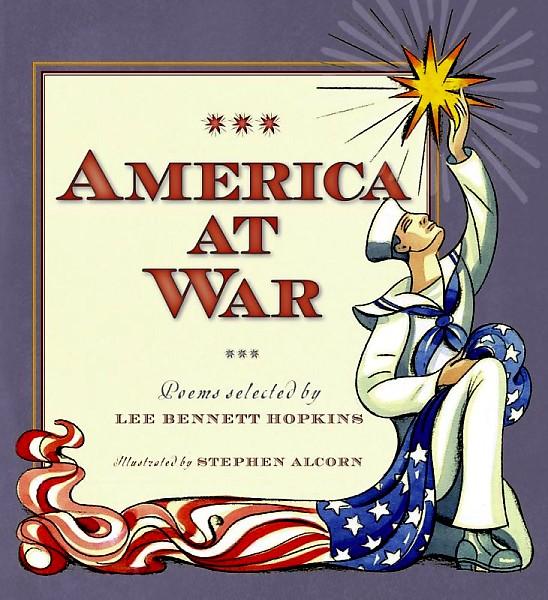
 America At War

Hopkins, Lee Bennett. 2008. AMERICA AT WAR. Ill. by Stephen Alcorn. New York: Margaret K. McElderry Books. ISBN 978-1-4169-1832-5

Review:

AMERICA AT WAR is a collection of 54 poems. As the introduction tells us, though, this book is not about war, rather it is about the poetry of war. Each poem was selected by Lee Bennett Hopkins for its emotional impact. AMERICA AT WAR is divided into eight sections: The American Revolution, The Civil War, World War I, World War II, Korean War, Vietnam War, Persian Gulf War, and finally, the Iraq War. The book ends with a vocabulary lesson for us all. Poet Ann Wagner shows us how, with carefully chosen, politically correct words, we can detach ourselves from the atrocities of war.

Each section begins with a quote from a poet, philosopher, or military leader and a brief commentary on that particular war. Many different emotions are found in these poems, including a young soldier who longs for his mother to tuck him into bed, a family who sings happy birthday to a photo of a father who is far from home, a sister who misses her brother and prays enemy forces miss him as well, and a father expressing his love for a newborn daughter he has never seen.

Throughout the book, illustrator Stephen Alcorn enhances the poems with his sometimes haunting watercolor artwork in muted colors.

AMERICA AT WAR is a collection of moving, heartfelt poems that provides many different perspectives on the effects of war and the toll it takes on men, women, and children everywhere. It reminds us that our freedom comes at an incredibly high price.

Highlighted Poem:
As I Do Now by Katie McAllister Weaver

We were told to take
only what was too important
to leave behind

Even frantic rantings
of our neighbors fleeing screams
couldn't help us decide.

The relentless threat of Nazis
muddled our every thought --
again,
a night like
KRISTALLNACHT!

We grabbed what we could carry.
Yet, eventually favorite photos,
stacks of books, mounting pile of memories
lined roadsides like gravestones
until all we had left were backpacks of food
and the weight of wishing
we could have brought more.

My small crystal turtle, though,
stashed under my shirt
reminded me how
I never needed it
as much as I do now.


Possible Uses:

Use "As I Do Now" to introduce a unit on The Holocaust.
Have students write a personal narrative describing things they would have wanted to take with them - what is "too important to leave behind".

Tuesday, January 18, 2011

Class Change!

Below are reviews for LS 5603 Literature for Children and Young Adults. Future posts are reviews for LS 5663 Poetry for Children and Young Adults.

Sunday, August 8, 2010

Genre 6: Rapunzel's Revenge


Rapunzel's Revenge

Hale, Shannon and Dean. 2008. Rapunzel's Revenge. Ill. by Nathan Hale. New York: Bloomsbury USA Children's Books. ISBN 978-1-59990-288-3

Plot Summary

Rapunzel was raised by Mother Gothel, the woman Rapunzel had always thought was her mother. Rapunzel led a charmed life within the confines of The Villa but always questioned what lie on the other side of the large stone wall.

On her twelfth birthday, Rapunzel could stand it no longer and climbed over the wall. What she saw was shocking! Outside the Villa, every living thing was dried up and withered, including the people who had been enslaved by Mother Gothel. During her visit outside the Villa, Rapunzel meets her true mother, a slave of Mother Gothel's. When she confronts Mother Gothel, Rapunzel is taken away and locked in a magic tree house far above the forest floor.

Rapunzel lived in this tree house prison for four long years. During her imprisonment, her nails, hair, and a nearby tree grew with abandon. Rapunzel, using her hair as a rope, lassoed the nearby tree and swung herself out of her prison.

Meeting many interesting people along the way, teaming up with Jack, a boy on the run, and using her braids as lariats and whips, set off to release her enslaved mother and exact her revenge on Mother Gothel.

Critical Analysis

Using the old west as a setting, Shannon and Dean Hale have brought the story of Rapunzel to America in their graphic novel retelling of a classic fairytale. A clear sense of place is achieved using old west idioms, horses, and gunfights. The Hale's give Rapunzel's Revenge another twist by interweaving elements of another fairytale favorite, Jack and The Beanstalk.

In the beginning, Rapunzel's Revenge sticks fairly close to the original story. It, however, makes a sharp turn when we see our damsel in distress take matters into her own hands. Readers will appreciate this twist where, instead of waiting for her prince charming to rescue her, Rapunzel creates her own means of escape.

This graphic novel retelling also offers an obvious juxtaposition for readers as the story is told in three layers. We have the dialogue within the story, Rapunzel's narration of the events, and Nathan Hale's comic book illustrations. These layers add a level of humor and depth to the story that readers will find intriguing.

Nathan Hale, no relation to Shannon and Dean, is the illustrator for Rapunzel's Revenge. His pictures are an intricate part of the story as they sometimes tell the "true" story. For example, when Rapunzel escapes from the tree the text is, "And then at last I managed to lasso the tree, swing gracefully from my prison, climb down the trees branches, and land triumphantly on the forest floor." The picture shows a slightly different story; Rapunzel swinging from the tree with a look of terror, breaking branches as she falls through the trees, and splashing to a decidedly ungraceful stop in the swamp below.

Nathan Hale also helps with comprehension of the story as his illustrations keep the storyline clear for readers.The pictures aid in keeping the storyline clear. For example, he uses nearly transparent pictures to denote flashbacks and dreams; this keeps readers clear on what is happening at all times.

Review Excerpts

Booklist: "This graphic novel retelling of the fairy-tale classic, set in a swashbuckling Wild West, puts action first and features some serious girl power in its spunky and strong heroine."

Horn Book starred review: "The gutsy tale is particularly well suited to its format, with illustrations mixing the familiar and offbeat. High action, sensory thrills, and the wisecracking heroes are clearly conveyed through image cropping, text placement, and facial emotional cues."

Connections

Students can read Calamity Jack to find out what happens next to Jack and Rapunzel.

Students can compare the original story of Rapunzel with Rapunzel's Revenge using a Venn diagram or Double Bubble Thinking Map.

Related Books

Calamity Jack by Shannon and Dean Hale

Forest Born by Shannon Hale

Book cover from www.librarything.com

Saturday, August 7, 2010

Genre 6: The Graveyard Book

The Graveyard Book

Gaiman, Neil. 2008. The Graveyard Book. Ill. by Dave McKean. New York: Harper Collins. ISBN 978-0-06-053092-1

Plot Summary

While his family is being murdered by the man Jack, the fourth member of the family, a toddler, escapes from the house through the open door. The toddler makes his way outside and up the hill to the graveyard. Seeing the boy is in danger, and at the request of his now dead mother, the ghosts of the graveyard agree to take him in and protect him from those who mean him harm. Adopted by Mr. and Mrs. Owens, the boy is given the name Nobody Owens, Bod for short. Bod is given the Freedom of the Graveyard, allowing him to live in the real world and that of his ghost friends. One inhabitant of the graveyard, Silas, is neither living nor dead. As he is the only one who can leave the graveyard, Silas agrees to be Bod's guardian and protect him until Bod can protect himself.

With the help of his new parents, his guardian Silas, and the many ghostly inhabitants of the graveyard, Bod learns his ABC's, how to Fade and Dreamwalk, and the history of the world. As he grows older, he yearns to be part of the living world, but somewhere out there lurks a killer who is determined to destroy him and leaving the graveyard could mean death for Bod.

At teh age of 14, Bod befriends a living girl who leads him to discover the circumstances of his familiy's murder. Unfortunately, the girl unknowingly leads the killer straight to Bod. Now Bod must use all the knowledge he has gained in the graveyard to outwit those who wish him harm.

Critical Analysis

While certain parts of this fantasy novel might be scary for younger children, middle school children and young adults will relate to Bod’s experiences of leaving the safety of home, attending school, encountering bullies, and learning the life-lessons that all adults are not worthy of trust and at some point you have to make your own way in the world.

Gaiman relies heavily on dialogue in this book which might prove tedious for reluctant readers, though he does paint a vivid picture of the graveyard and its endearing inhabitants – who are introduced by the inscription on their headstone. Gaimen uses these multi-generational ghosts to add levity to the story. The book also features black and white drawings by illustrator Dave McKean. Gaimen uses a series of puns on the name Jack portraying the villain a bit less frightening than he should be, though it does not get in the way of the story.

The Graveyard Book, while dark with the themes of murder, ghosts, and deception also manages to be uplifting with the themes of love, friendship, family, and good triumphing over evil.

Review Excerpts

Booklist starred review: "This is an utterly captivating tale that is cleverly told through an entertaining cast of ghostly characters. Although marketed to the younger YA set, this is a rich story with broad appeal and is highly recommended for teens of all ages."

Horn Book: "Warmly rendered by the author, Bod's ghostly extended family is lovably anachronistic; their mundane, old-fashioned quirks add cheerful color to a genuinely creepy backdrop. McKean's occasional pages and spots of art enhance the otherworldly atmosphere with a flowing line, slightly skewed figures, and plenty of deep grays and blacks."

School Library Journal: "Bod's love for his graveyard family and vice versa provide the emotional center, amid suspense, spot-on humor, and delightful scene-setting."

Connections

As Gaimen states his inspiration for the story as Rudyard Kipling's The Jungle Book, lessons could include a comparison of the two stories.

Related Books

Other books by Neil Gaiman:

Coraline

Interworld

M is for Magic

Book cover from www.librarything.com

Friday, July 30, 2010

Genre 6: Fiction, Fantasy, and YA


The First Part Last

Johnson, Angela. 2003. The First Part Last. New York: Simon & Schuster. ISBN 0-689-84922-2.

Plot Summary

Bobby was a typical urban teenager. He liked nothing better than hanging out with his friends, eating pizza at Mineo's, tagging a blank wall, and spending time with his girlfriend, Nia. Now, he would like nothing better than a full night of uninterrupted sleep. Unfortunately, that is not in his immediate future.

On Bobby's sixteenth birthday, Nia tells him she is pregnant. The First Part Last is told in a Then/Now format. The 'Then' is the time leading up to the birth of their daughter, Feather. Readers see the fear and indecision that comes with making the life-altering decision of whether or not they should put their baby up for adoption. The 'Now' shows us Bobby's struggle to do the "right thing".

Throughout the story readers will notice Nia, the mother, is blatantly missing. We see Bobby's struggle through school days after many sleepless nights. We see a boy become a man as he deals with the consequences of his decisions. Though we receive hints along the way, it is not until the end that readers learn the reason for Nia's absence.

Critical Analysis

Winner of The Coretta Scott King Award and the Michael L. Printz Award, The First Part Last is a short, quick read but a powerful and moving story. Johnson gives readers the treat of two twists in this story. First of all, it is told from the point of view of the teen father rather than the teen mother. Second, the book is free of stereotypes as our main character, though an African American boy living in inner-city New York, is not involved in drugs or gangs. He and Nia, both, are from middle to upper-middle class families. Bobby is planning on graduating high school early and attending college. He is on the road to becoming a successful young man.

Johnson organized the book in alternating chapters that allows readers to experience Bobby's life before and after the birth of his daughter. In the "Then" chapters, Johnson tackles the tough issues that teenagers who find themselves in these situations have to face. Readers are led through a series of events such how to tell the parents, whether or not to keep the baby, and the many doctor’s appointments that pregnant women have to face. We see how the pregnancy affects Bobby's friends J. L. and K-Boy. It is through their conversations that Johnson discusses the use of birth control, and we see varying viewpoints on the subject.

The First Part Last does not romanticize teen pregnancy as we see in the "Now" chapters. Readers witness Bobby struggle with taking sole responsibility for his child. Finding daycare is a major struggle for him as is waking many times during the night to feed the baby, change the baby, and sometimes, just to play with the baby because that's when she likes to play. Though he lives with his mother, he and he alone is responsible for all of these things. The story is told in a manner that draws the reader in; we feel his exhaustion, fear, and trepidation. We feel his helplessness when tells us he wants "nothing else but to run crying into my own mom's room".

The ending is both heart wrenching and fulfilling at the same time. Readers see that Nia does not choose to be absent. Her absence is beyond her control. Though we are given clues along the way, it is not until the end of the story that Johnson reveals the mystery behind Nia's absence. Due to the development of eclampsia, Nia is in an irreversible vegetative coma and must live in a nursing home.

The theme of this realistic fiction novel is accepting responsibility and doing the right thing, whatever that may be. Teenagers will enjoy this powerful and moving story. It will give them insight as to what true responsibility is and what must be sacrificed because of ones actions and choices.

Review Excerpts

School Library Journal: "Brief, poetic, and absolutely riveting, this gem of a novel tells the story of a young father struggling to raise an infant. Scenes in which Bobby expresses his love for his daughter are breathtaking. Teens who enjoyed Margaret Bechard's Hanging on to Max (Millbrook, 2002) will love this book, too, despite very different conclusions."

Booklist: "From the first page, readers feel the physical reality of Bobby's new world: what it's like to hold Feather on his stomach, smell her skin, touch her clenched fists, feel her shiver, and kiss the top of her curly head. Johnson makes poetry with the simplest words in short, spare sentences that teens will read again and again. The great cover photo shows the strong African American teen holding his tiny baby in his arms.

Connections

This book would lend itself to a cross-curricular unit. Language Arts classes could write letters to Nia explaining what is happening with Bobby and Feather. Math classes could find the most recent statistics about teen pregnancy in America and create graphs explaining the results. Art classes could create a piece of art to represent Bobby's emotions throughout the novel as we see him do when he tags the blank wall in the story.


Obviously, this would also be a great book in a lesson concerning taking responsibility for oneself and the consequences of our choices and actions.

Related Books

Bechard, Margaret. Hanging on to Max. ISBN 0340883707

Johnson, Angela. Heaven. ISBN 978-0689822902

Johnson, Angela. Looking for Red. ISBN 978-0689863882

Book cover from http://www.librarything.com/